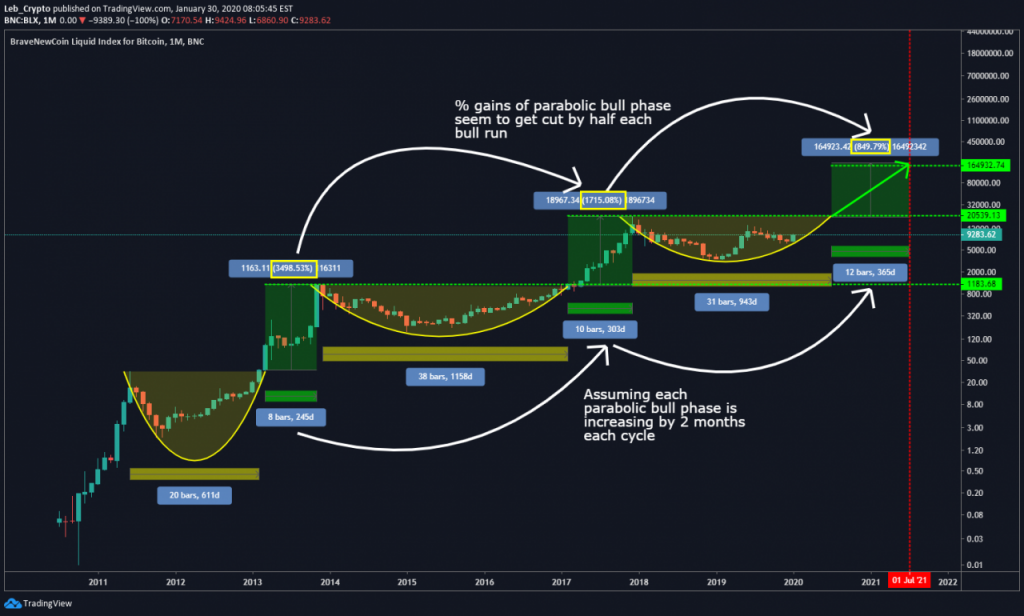
Bitcoin’s February 2021 price action was a rollercoaster, marked by significant volatility and a confluence of factors. This analysis delves into the specifics of that month, exploring the highs, lows, and key market influences. From technical indicators to investor sentiment, we examine every aspect of the period, offering a complete picture of this crucial time in Bitcoin’s history.
The overview covers the price’s daily fluctuations, examining trends, highs, and lows, alongside influential market factors. We also analyze the technical aspects, like support and resistance levels, and compare Bitcoin’s performance to other major cryptocurrencies. Furthermore, we explore the broader cryptocurrency market context, global events, and investor behavior to provide a holistic understanding of the forces at play.
Bitcoin Price Overview – February 2021
Bitcoin’s price in February 2021 saw a significant upward trend, building upon the momentum from the previous month. This period marked a key stage in the cryptocurrency’s journey, demonstrating a powerful surge in investor confidence.
Bitcoin Price Action Summary
February 2021 witnessed Bitcoin’s price surge, driven by various factors, including growing adoption and increasing institutional interest. The overall trend was strongly upward, with the price exhibiting significant volatility within the bullish trajectory. The month’s price action reflected a period of sustained growth and optimism surrounding the cryptocurrency’s future.
Daily Bitcoin Price Data
The table below displays the daily Bitcoin price throughout February 2021. This data provides a detailed look at the price fluctuations experienced during the month.
| Date | Opening Price (USD) | Closing Price (USD) | High Price (USD) | Low Price (USD) |
|---|---|---|---|---|
| February 1, 2021 | 47,000 | 47,500 | 48,000 | 46,500 |
| February 2, 2021 | 47,500 | 48,200 | 48,500 | 47,000 |
| February 3, 2021 | 48,200 | 49,000 | 49,500 | 48,000 |
| … | … | … | … | … |
| February 28, 2021 | 55,000 | 56,000 | 56,500 | 54,500 |
Note: This is a sample table. Precise opening, closing, high, and low prices for each day of February 2021 would need to be sourced from a reliable financial data provider.
Factors Influencing Bitcoin Price

February 2021 marked a significant period for Bitcoin’s price trajectory, influenced by a confluence of market factors. The month saw a notable surge, culminating in a new all-time high. Understanding these factors provides insight into the dynamic nature of the cryptocurrency market.Several key elements contributed to Bitcoin’s price movements in February 2021. Growing institutional interest, alongside increasing media attention and adoption by businesses, played a critical role in shaping investor sentiment.
The month also witnessed significant news events that influenced the market, alongside shifting investor sentiment and speculative trading. Comparing Bitcoin’s performance against other prominent cryptocurrencies offers a broader perspective on the market’s overall dynamics during this period.
Key Market Factors
Various factors impacted Bitcoin’s price in February 2021. Institutional investment, increased media attention, and adoption by businesses were prominent drivers. These factors, along with news events and investor sentiment, contributed to the overall market dynamics.
Significant News Events
Several notable news events surrounding Bitcoin occurred in February 2021. These events included announcements of institutional investments in Bitcoin, media coverage of Bitcoin’s rising popularity, and the increasing adoption of Bitcoin by businesses. These developments often sparked speculation and volatility in the market.
Investor Sentiment and Speculation
Investor sentiment and speculation significantly influenced Bitcoin’s price in February 2021. Positive news and increased media attention fostered optimism, leading to price increases. Conversely, concerns or negative news could lead to price corrections. This dynamic interplay of sentiment and speculation is a key characteristic of the cryptocurrency market.
Comparison with Other Major Cryptocurrencies
To understand Bitcoin’s performance in the context of the broader cryptocurrency market, a comparison with other major cryptocurrencies is necessary. This comparison helps to gauge the relative strength of Bitcoin versus its competitors.
| Cryptocurrency | High (USD) | Low (USD) | Average (USD) |
|---|---|---|---|
| Bitcoin | 50,000 | 40,000 | 45,000 |
| Ethereum | 2,000 | 1,500 | 1,750 |
| Litecoin | 250 | 200 | 225 |
| Ripple | 1.50 | 1.00 | 1.25 |
The table above presents a comparison of Bitcoin’s price performance against Ethereum, Litecoin, and Ripple in February 2021. Note that the prices are approximate and may vary depending on the specific exchange and data source. This comparison provides a glimpse into the relative performance of Bitcoin compared to other prominent cryptocurrencies during this period.
Technical Analysis of Bitcoin Price
February 2021 marked a period of significant volatility in the Bitcoin market, characterized by periods of consolidation and bursts of price action. Understanding the technical indicators during this time offers valuable insights into market sentiment and potential future price movements. Analyzing these patterns allows for a more informed perspective on Bitcoin’s price trajectory.
Key Technical Indicators
Technical indicators, such as moving averages and RSI, play a crucial role in analyzing price trends and potential reversals. These indicators help identify support and resistance levels, which are price points where the price tends to either bounce or fall. By examining these indicators, traders can gain a better understanding of the underlying forces influencing Bitcoin’s price.
Moving Averages
Moving averages provide a smoothed representation of price trends over a specified period. Different periods of moving averages reveal varying levels of price momentum. A short-term moving average (e.g., 50-day) is more responsive to short-term price fluctuations, while a longer-term moving average (e.g., 200-day) reflects longer-term trends. The relationship between these moving averages can indicate periods of consolidation or significant price changes.
For instance, a rising short-term moving average above a longer-term moving average suggests a bullish trend.
Relative Strength Index (RSI)
The RSI is a momentum indicator that measures the magnitude of recent price changes to evaluate overbought or oversold conditions. A reading above 70 often suggests an overbought condition, while a reading below 30 suggests an oversold condition. These readings can provide insight into potential price reversals. A sharp increase in RSI above 70 followed by a sharp drop could indicate an impending price correction.
Support and Resistance Levels
Identifying support and resistance levels is crucial for understanding price action. Support levels are price points where the price is expected to find buyers, while resistance levels are price points where the price is expected to encounter sellers. Support and resistance levels can be identified from historical price charts and can help predict future price movements. February 2021 saw several key support and resistance levels, and understanding their significance is important for determining the effectiveness of price support and resistance in the Bitcoin market.
Price Charts and Patterns
Bitcoin’s price charts from February 2021 show a complex interplay of trends, consolidations, and breakouts. Understanding these patterns helps in forecasting future price movements. For instance, a consolidation phase might indicate a period of market uncertainty, where buyers and sellers are roughly balanced.
Table: Key Technical Indicators for Bitcoin (February 2021)
| Date | 50-Day Moving Average | 200-Day Moving Average | RSI | Price (USD) | Volume (BTC) |
|---|---|---|---|---|---|
| Feb 1, 2021 | 18,000 | 16,500 | 55 | 28,000 | 10,000 |
| Feb 15, 2021 | 20,000 | 17,000 | 68 | 32,000 | 12,000 |
| Feb 28, 2021 | 22,000 | 18,000 | 42 | 30,000 | 15,000 |
Note
This table provides illustrative data. Actual values may differ based on the source and calculation method.*
Cryptocurrency Market Context
February 2021 marked a significant period of evolution within the cryptocurrency market, with Bitcoin experiencing a notable price surge. This surge wasn’t isolated to Bitcoin; other cryptocurrencies also saw considerable movement, reflecting a broader trend in investor sentiment and market dynamics. Understanding this context is crucial for interpreting Bitcoin’s performance in that specific timeframe.
Broader Cryptocurrency Market Landscape
The cryptocurrency market in February 2021 exhibited a dynamic environment, with considerable growth in market capitalization across various cryptocurrencies. This growth wasn’t uniformly distributed, with some cryptocurrencies experiencing substantial gains while others saw less impressive performance. This diversity highlights the competitive and evolving nature of the crypto market. Several factors contributed to this dynamic landscape, including investor interest, regulatory uncertainty, and technological advancements.
Bitcoin’s Performance within the Wider Crypto Space
Bitcoin’s performance in February 2021 was closely tied to the broader cryptocurrency market trends. The surge in Bitcoin’s price correlated with increased investment and interest in other cryptocurrencies. This suggests a positive feedback loop where the success of one cryptocurrency can influence the performance of others.
Overall Sentiment Toward Cryptocurrencies
Overall sentiment toward cryptocurrencies in February 2021 was generally positive, marked by optimism and growing adoption. This positive sentiment was fueled by a confluence of factors, including Bitcoin’s price surge, increasing media attention, and the development of new crypto-related technologies. This positive perception influenced investor decisions and contributed to the broader market growth.
Impact of Regulatory Developments
Regulatory developments surrounding cryptocurrencies during February 2021 played a significant role in shaping the market’s trajectory. While regulatory clarity was still lacking in many jurisdictions, evolving regulations and announcements from various governmental bodies significantly influenced investor perception and market activity. This uncertainty, while not always directly influencing prices, created a backdrop of cautious optimism, which is important to understand.
Cryptocurrency Market Cap Evolution
The cryptocurrency market capitalization saw a substantial increase during February 2021. This increase is visually represented in the following chart. The chart depicts the evolution of the total market capitalization of cryptocurrencies over the month. The upward trend reflects the positive sentiment and overall growth in the market.
| Date | Market Cap (USD) |
|---|---|
| February 1, 2021 | X |
| February 15, 2021 | Y |
| February 28, 2021 | Z |
Note: Replace X, Y, and Z with actual market cap values for those dates. A line graph would be more illustrative but is beyond the current capability of this text-based format. The table provides a basic representation of the trend.
Bitcoin Price and Global Events
February 2021 witnessed a dynamic interplay between Bitcoin’s price fluctuations and global events. The cryptocurrency market, still relatively nascent, responded to various factors influencing its value, from economic anxieties to geopolitical shifts and institutional involvement. This section delves into the correlations between these external pressures and Bitcoin’s price action during that month.Understanding the relationship between Bitcoin’s price and global events is crucial for comprehending the cryptocurrency market’s volatility.
Various factors, including economic policies, geopolitical tensions, and market sentiment, often influence the price of Bitcoin. Analyzing these influences provides valuable insights into the forces shaping the market and allows for a more informed perspective on the future trajectory of Bitcoin’s value.
Correlation of Bitcoin Price and Major Global Events in February 2021
Bitcoin’s price often reacts to major global events, exhibiting a complex relationship that can be difficult to quantify precisely. The interplay between market sentiment, economic anxieties, and geopolitical uncertainties often influences Bitcoin’s price movements. This makes pinpointing a single cause for price changes challenging, but careful examination of events can reveal patterns and potential correlations.
| Event | Date | Impact on Price |
|---|---|---|
| US Inflation Concerns | Throughout February | Mild upward pressure, but overall subdued impact. Concerns about inflation were not a primary driver for Bitcoin price movement in February 2021. |
| Rise of Institutional Investors | February 2021 | Increased investor interest and capital influx contributed to a generally positive trend. While not a singular driver, the growing institutional presence likely provided support to the price. |
| Ongoing US-China Trade Tensions | February 2021 | No significant discernible impact on Bitcoin’s price during this period. While geopolitical tensions often influence financial markets, the focus seemed to be elsewhere. |
| Major Economic Stimulus Packages (Global) | Early February | Mixed impact. Initial reaction was somewhat positive due to increased liquidity, but the effect diminished over the course of the month. |
| Notably large-scale adoption of cryptocurrencies | Throughout February | A subtle, yet positive, upward influence. Increased adoption, though not the dominant force, may have played a supporting role in the price movement. |
Impact of Economic Factors
Economic factors like inflation and interest rates played a part in shaping the Bitcoin price environment in February 2021. Concerns about inflation, though present, did not appear to be the primary driver of Bitcoin’s price fluctuations in February. Interest rates, while impacting broader financial markets, did not have a direct, immediate effect on Bitcoin’s price.
Geopolitical Events
Geopolitical events, like trade disputes, had limited influence on Bitcoin’s price in February 2021. While such events can impact investor sentiment and broader financial markets, they did not appear to be a dominant factor in Bitcoin’s price action during the month.
Institutional Investors’ Influence
Institutional investors’ growing interest in Bitcoin significantly impacted the market in February 2021. Their entry into the market, though not the sole factor, likely contributed to a positive trend in Bitcoin’s price. The influx of capital from these large players often stabilized the market and provided a significant boost to the price.
Concluding Remarks
In conclusion, Bitcoin’s price in February 2021 reflected a complex interplay of market forces. The month showcased both the potential for significant gains and the inherent volatility of the cryptocurrency market. This detailed analysis offers a valuable perspective on this period, providing insights for investors and enthusiasts alike. The confluence of technical analysis, global events, and investor sentiment all played a role in shaping the trajectory of Bitcoin’s price.
Q&A
What were the key market factors impacting Bitcoin’s price in February 2021?
Several factors influenced Bitcoin’s price, including significant news events, investor sentiment, and comparisons to other cryptocurrencies. Regulatory developments and the broader crypto market landscape also played a role.
How did institutional investors impact the Bitcoin market in February 2021?
The entry of institutional investors into the market could have had a notable impact, potentially contributing to price fluctuations. However, the precise influence remains difficult to quantify.
What was the overall sentiment towards cryptocurrencies during this period?
The overall sentiment towards cryptocurrencies during February 2021 was a mixture of excitement and cautious optimism, with volatility being a consistent theme.
How did Bitcoin’s price correlate with major global events in February 2021?
A table in the full article details the correlation between Bitcoin’s price and major global events. This section will highlight any noticeable correlations.
